• Sponsors

  • Categories

  • Archives

  • Sponsors

Sacrifice and the Family of Adam

(Back to OT Junior Seminary Overview)

Old Testament Lesson 6: Sacrifice and the Family of Adam

To Prepare: Read Moses 5; print a copy of the activity below for each child participating.

Redemption from the Fall

To Teach: Begin with a prayer. I chose to do a lot of summarizing and explaining in this lesson instead of straight reading. First, we talked about how after Adam and Eve left the garden they had to grow their own food and they started having children. Then, their children grew up and got married and there started to be people in the land.

Together, read Moses 5:4-6. Explain that Adam and Eve could not see God anymore, but they could hear Him and get help with their problems. They had been commanded to offer special sheep (the firstlings of the flock) as a sacrifice to God . . . I had to explain what that meant. We mentioned tithing as something that we give as an offering to God. Adam didn’t know why he was supposed to sacrifice the sheep.

Next, read Moses 5:7-9. Explain that the sacrifice of a perfect, firstborn, male sheep was like the sacrifice that Jesus would make. There were good consequences and bad consequences of the Fall, but Jesus would make it possible for the bad consequences to be taken away. We talked a little more about that here. (Refer to the activity sheet if desired.)

After I read/summarized/explained the story of Cain and Abel, we did our activity sheets. It’s a cut and glue, so be sure you know where your scissors and glue sticks are before you get started.


(Go to Lesson 7)

Facebooktwitterredditpinterestlinkedinmailby feather

The Fall

(Back to OT Junior Seminary overview)

Old Testament Lesson 5: The Fall

To Prepare: Read Moses 4. Be prepared to help children understand the unfamiliar terms below; print off one copy of the activity pamphlet. If you’re feeling ambitious, cut apart the words on page 4 before time to teach.

NEW! I made a smaller version for notebooking that is only 2 pages.

Beguile: Deceive, lie to

Thou beholdest: You see

Full Version
The Fall Activity Packet

Notebooking Version

To Teach: Begin with a prayer. Slowly read Moses 4:6-13 together, helping the children understand what is happening in the story. We emphasized that Satan thought he was being clever and sneaky, but he didn’t know all of God’s plan.

Next, read Moses 4:14-19. I chose to summarize and explain the aftermath (v. 20-32) rather than reading it, and then we moved on to the activity.

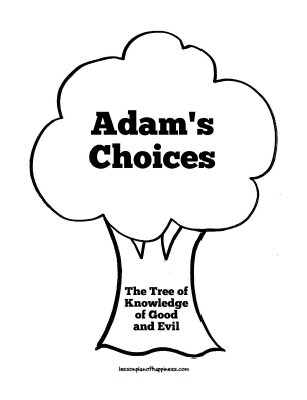
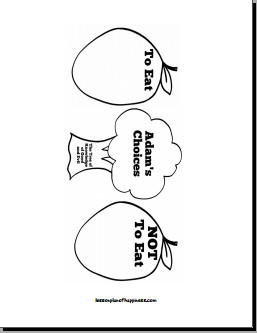
If you like, have the children color the tree and the pieces of fruit. Hang them up with one piece of fruit on each side, and then help children sort the consequences and tape or glue them to the correct papers. By this point, my kids were pretty easily able to figure out which went where, although they needed some help with the definition of “progress” (I used ‘grow, and change, and get better.’)

We took time afterward to talk more in depth about why it was so important that Adam and Eve eat the fruit. I asked my boys what could make it worth sadness and pain and death and we talked about how children were necessary for us to get our chance to follow the Plan, and how without the Fall Adam and Eve could never grow or move forward. Then we talked about why God would tell Adam not to eat the fruit if it was so important. Moses 3:17 and 2 Nephi 2:25 are good verses to read in this conversation; basically we boiled it down to the fact that God would not force Adam and Eve into a life of death and pain. They had to willingly choose mortality for the Plan to move forward.

(Go to Lesson 6)

Facebooktwitterredditpinterestlinkedinmailby feather

The Creation of Eve

(Back to OT Junior Seminary overview)

Old Testament Lesson 4: The Creation of Eve

This is where we discuss the seventh day, what was special about the creation of Eve, and lay the groundwork for the lesson about the Fall.

To Prepare: Read Moses 3. Print off or copy down the shortened list of unfamiliar terms below and print a copy of the activity page for each child participating.

Host: many, a lot of
Sanctified: made holy
Spritual/Spiritually: Eternal; not subject to death
Flesh: Mortal life
Naturally: Mortal, will die someday
Sphere: Condition
Dress: Take care of
Freely eat: Eat without consequences
Meet: Right, good, or fitting
Stead: Place
Cleave unto: Be closest and stay with

Drawing the Garden of Eden

To Teach: Begin with a prayer. Read Moses 3:1-3 together and discuss how it relates to the commandment to keep the Sabbath holy. Next, read Moses 3:7-9 and 15-17 and discuss the creation of Adam and the filling of the Garden. Talk about what kind of plants might be in the garden. Emphasize the commandment in verse 17 and ask them if they would eat fruit that would make them die.

Finally, read Moses 3:18 and 21-25. Explain the concept of ‘cleaving’ and tie it to marriage, and take special care to explain what it meant that they were not ashamed of being naked (again, we’re setting up for the next lesson about the Fall).

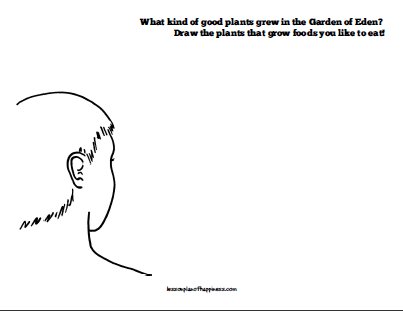
Hand out the activity sheets and let the kids draw plants that grow their favorite fruits and vegetables. (Fruit trees would be a good suggestion for kids who aren’t very familiar with garden plants.)

(Go to Lesson 5)

Facebooktwitterredditpinterestlinkedinmailby feather